

Supporting the Philippine Government, partners and communities on climate mobility analytics to inform policy, planning, programming, and investment frameworks.
The Philippines stands at the frontlines of the global climate displacement crisis. As climate hazards intensify, forward-looking projections indicate escalating exposure to tropical cyclones, extreme precipitation, sea-level rise, and extreme heat, all of which will continue to impact human mobility patterns. IOM Philippines and the Climate Mobility Innovation Lab work with Government and other stakeholders to strengthen evidence-based policy, planning, programming and investment frameworks on climate mobility. In partnership with the University of the Philippines Resilience Institute (UPRI), and in collaboration with national and local partners, including the Department of Environment and Natural Resources, Department of Social Welfare and Development, Climate Change Commission, Office of Civil Defense, and Local Government Units, the Risk Index for Climate Displacement (RICD) identifies municipalities at high risk of future climate displacement and the primary triggers of displacement within these areas. This evidence base then feeds into targeting and design of initiatives supported through the Climate Catalytic Fund (CCF) to strengthen locally-led adaptation efforts, and the strengthening of investment planning relating to climate mobility, as reflected in the Philippine Climate Mobility Investment Plan – the first of its kind developed globally.
RICD
The Risk Index for Climate Displacement (RICD) supports the Government of the Philippines in strengthening climate adaptation and disaster risk management by identifying municipalities at high risk of climate-related displacement and assessing the primary triggers of displacement within these areas.
The macro-level analysis covers every municipality and city in the Philippines (admin level 3). Flood, landslide and storm surge analyses are published, while the multi-hazard analysis and future climate change scenarios are ongoing.
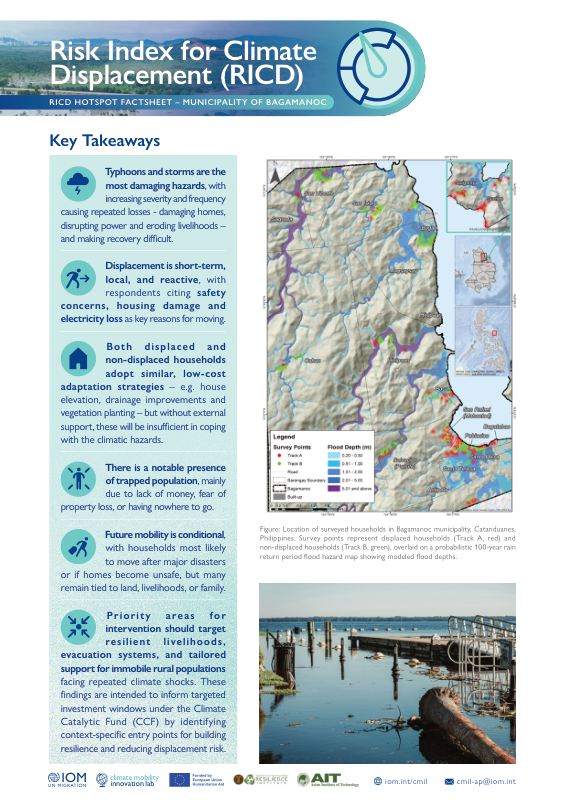
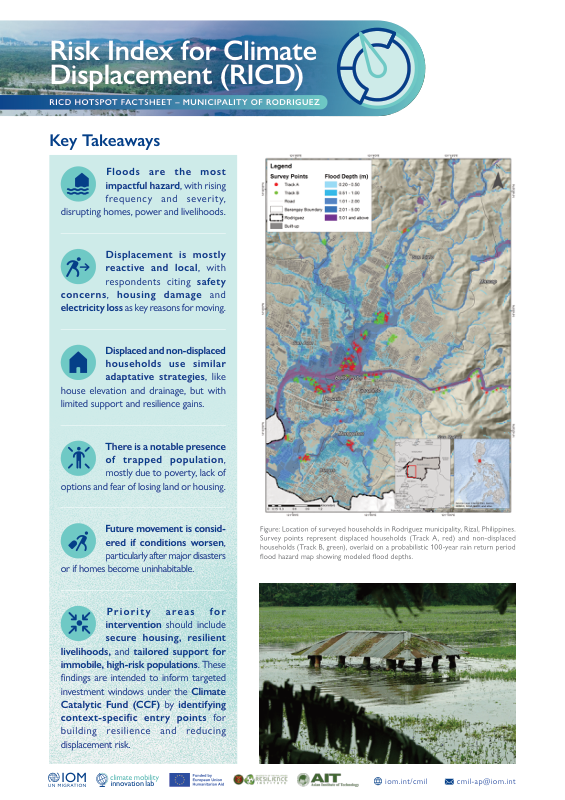
The micro-level analysis has been completed and published for two hotspots: Bagamanoc in Catanduanes and Rodriguez in Rizal.
RICD analytics inform the design and implementation of localised climate mobility adaptation initiatives in climate mobility hotspot municipalities, including interventions supported through the Climate Catalytic Fund (CCF). At the national and sub-national level, RICD also contributes to broader government planning and financing efforts on climate mobility, providing an evidence base to inform policies, strategies, and investments related to climate adaptation, loss and damage, and climate finance.

Risk tierEach area is ranked from 1 (very low) to 5 (very high) based on its relative risk of climate displacement. The risk score combines the hazard, exposure, and vulnerability layers. Tiers are relative within each country so scores shouldn't be compared across countries.No risk identified: the hazard doesn't affect this area or there is no population exposed.N/A: no data is available for this area.
This map is for illustration purposes only. The boundaries and names shown and the designations used on this map do not imply official endorsement or acceptance by the International Organization for Migration.
This map is for illustration purposes only. The boundaries and names shown and the designations used on this map do not imply official endorsement or acceptance by the International Organization for Migration.
Macro-level analysis (admin level 3)
| Baseline climate | Future climate | |
|---|---|---|
| Flood | Published | Planned |
| Landslide | Published | Planned |
| Storm surge | Published | Planned |
| Multi-hazard | Ongoing | Planned |
Micro-level analysis (hotspots)

CCF
CCF mobilises fast, match-funded (including blended finance) grants that turn risk and displacement evidence, including the Risk Index for Climate Displacement (RICD) where available, into concrete, on-the-ground, locally-led adaptation. As part of CMIL, it sits alongside RICD and other evidence, ensuring evidence, finance, and experimentation feed each other.
Climate Catalytic Fund projects in this country, drawn from the same live pipeline as the CCF project markers on the map above.
Try removing or changing a filter to see more projects.
CMIF
A Climate Mobility Investment Plan (CMIP) is a government-owned plan, co-designed by governments and IOM. It sets out where climate mobility risk is concentrated in a country, which interventions respond to it, and how they should be financed.
The first CMIP was developed by the Government of the Philippines, led by the Department of Environment and Natural Resources, the Department of Social Welfare and Development and the National Adaptation Plan Sub-Technical Working Group on Cultural Heritage, Population Displacement and Migration, with the technical support of IOM.
Investment themes
Developed under the Climate Mobility Investment Facility. Read about the Facility and see its country-status map on the CMIF page.