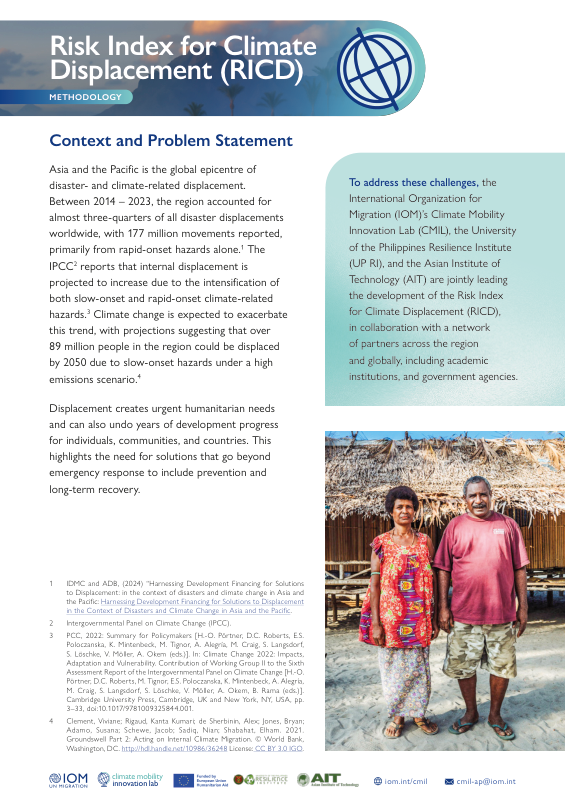

RICD uses a two-tiered approach combining macro-level quantitative displacement risk modelling with micro-level community-based research to identify climate displacement hotspots and provide data on the lived experience of communities in these hotspots.
The Risk Index for Climate Displacement (RICD) examines displacement risk at two inter-connected levels.
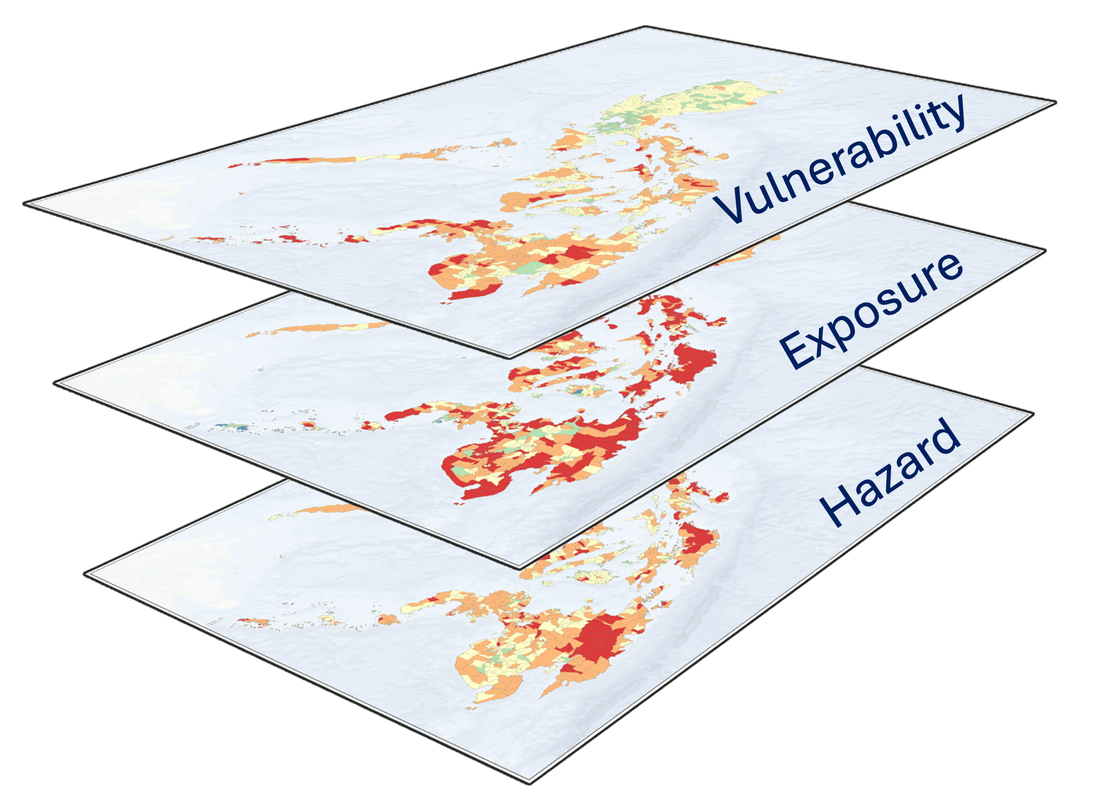
At the macro level, RICD maps climate displacement hotspots country-wide through risk analysis, comprising hazard, exposure and vulnerability. Through this process, each subnational administrative unit receives a displacement risk score, enabling identification and prioritisation of hotspots where displacement risk is highest. The risk scores are validated through observed displacement data and consultation with national stakeholders.
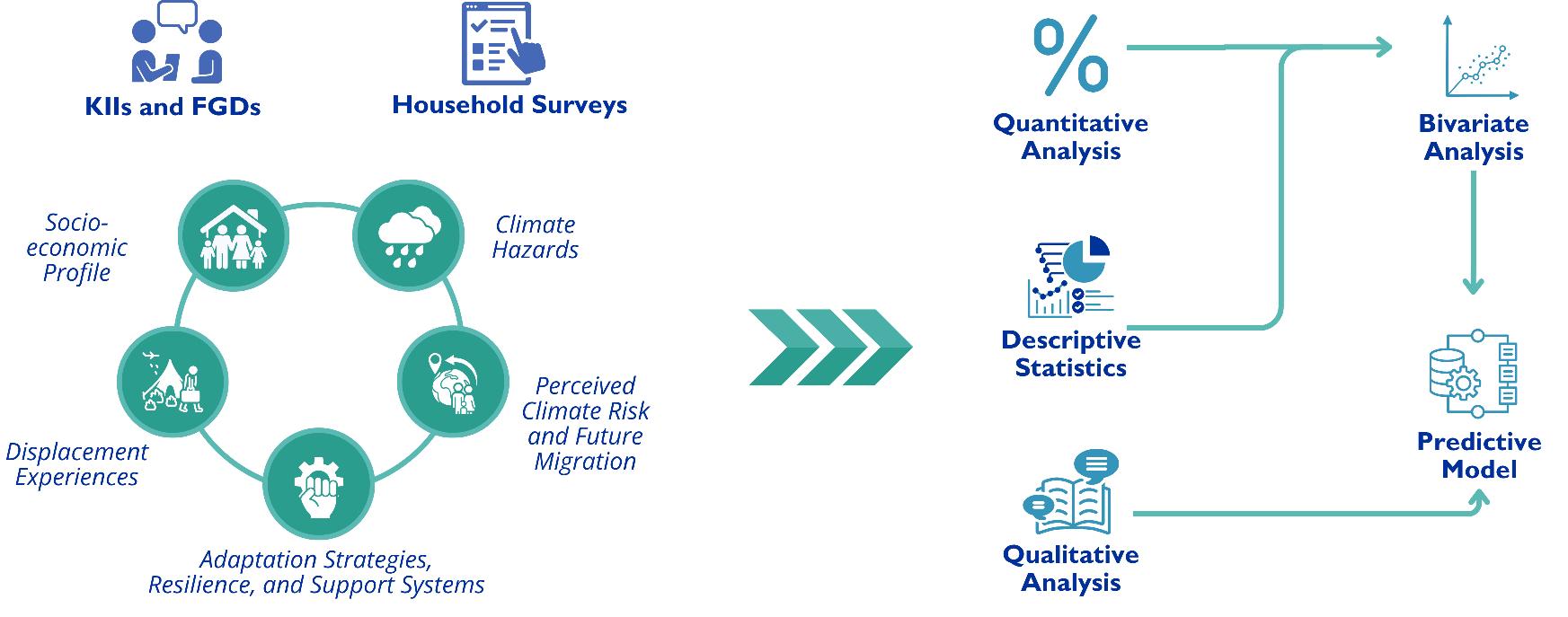
The micro-level component builds on the macro-level analysis to understand the mechanisms and conditions that lead to displacement or other forms of (im)mobility in identified hotspots. Through surveys and interviews, the micro-level builds the evidence base on mobility dynamics at the community level, and identifies when, why, and how displacement or other movements occur.
Co-creation of the methodology and data is one of RICD's distinguishing features. National research institutions, government agencies, and other data partners are involved in contextualising the RICD framework, models, and data collection to each country, ensuring that the data generated is accurate, empirically-grounded, and locally-owned.
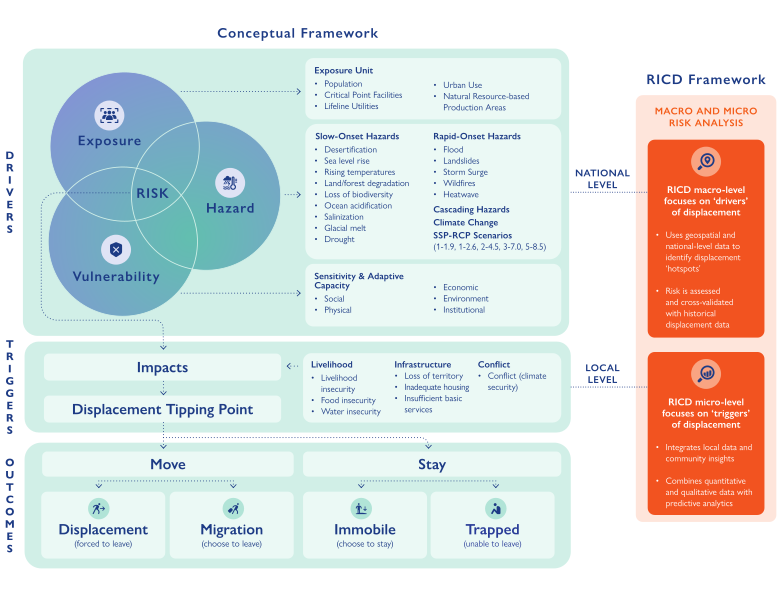

The macro-level analysis examines the underlying drivers of displacement through risk analysis. This follows the IPCC's AR5 framework1, which defines risk as the interaction of hazard intensity and frequency, exposure of populations and assets, and the vulnerability of affected systems and communities. The RICD macro-level adapts this framework to displacement risk by incorporating the mechanisms and pathways through which climate-related displacement occurs.
The macro-level is conducted at the national level to identify climate displacement hotspots across a country, at administrative level 2 or 3, depending on the size of the country. The displacement risk analysis yields 5 risk tiers (1 = very low to 5 = very high), which allows for comparison across areas and identification of locations where displacement risk is highest.
Displacement risk is computed per hazard, spanning rapid-onset hazards (e.g. floods, landslides, storm surge) and slow-onset hazards (e.g. sea-level rise and drought), and combined to produce a multi-hazard score of displacement risk. The macro-analysis is conducted for both baseline climate and future climate change scenarios. The hazards modelled are contextualised to each country, based on prevailing hazards and priorities of national stakeholders.
The displacement risk scores are validated through a combination of observed displacement data where available and in consultation with national stakeholders.
While the macro-level analysis gives an overview of displacement risk across a country, further analysis is required at the community level to understand why and how displacement or other types of movement occur, identify coping or adaptation strategies as well as gaps in such strategies, and ultimately capture the lived realities of communities. This is where the micro-level analysis comes in.
1 Intergovernmental Panel on Climate Change Fifth Assessment Report ↩
High-risk climate displacement hotspots identified through the macro-analysis are selected for in-depth community research through a three-tiered selection process:
Micro-level data collection typically involves the following:
This micro-level data serves to enrich the macro-level data by providing granular, ground-truthed evidence, capturing the decision-making processes, lived experiences of climate mobility, and circumstances of communities that risk scores alone cannot explain.
This grounded evidence is used to inform IOM's Climate Catalytic Fund (CCF), Climate Mobility Investment Plans (CMIPs) and broader climate adaptation financing, guide government policies and interventions, and to centre affected communities' voices and priorities within the data.
Every country implementation of RICD reflects the choices and contributions of national research institutions, government agencies, and regional bodies. The methodology is shaped by them, and continues to evolve through their engagement.
See our full partner network →