

20 October 2026
Third RICD Technical Workshop narrows down climate displacement hotspots in Thailand
As climate change intensifies hazards such as floods, heatwaves, and droughts, placing growing pressure on communities to move, IOM’s Climate Mobility Innovation Lab continues to develop the Risk Index for Climate Displacement (RICD) to identify where climate hazards intersect with socioeconomic vulnerabilities and guide adaptation planning.
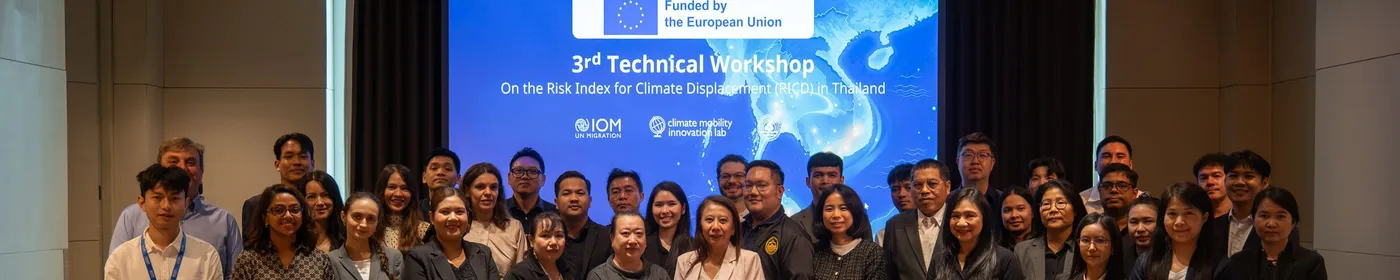
In collaboration with Thailand’s Department of Climate Change and Environment (DCCE) and Nanyang Technological University (NTU), IOM co-organized the third Technical Workshop on the RICD on 20 October 2026 in Bangkok. Funded by the European Union (DG INTPA), it brought together 29 participants from 12 national institutions.
Building on the second RICD Technical Workshop in August, Thai national institutions continued to shape the RICD in order to reflect national priorities and identify where climate displacement is most likely to happen.
Under NTU’s technical guidance, participants reviewed macro-level risk maps for floods, heat and drought, discussed improvements to indicators, and considered which forms of movement to capture. Opportunities were identified to enhance the accuracy of the index by incorporating additional national datasets and increasing granularity.
Preliminary risk rankings were reviewed alongside available historical disaster and displacement information to assess their consistency with observed impacts. As candidate locations emerged for all three hazards, IOM’s Climate Mobility and Innovation Lab (CMIL) will review and consolidate the feedback alongside DCCE to finalize the hotspot selection.
Candidate locations:
- Flooding Ayutthaya, Pathum Thani, Chiang Rai, Phitsanulok
- Extreme Heat Ubon Ratchathani, Udon Thani, Sisaket
- Drought Khon Kaen, Buriram, Nakhon Ratchasima
The next phase will focus on identifying the factors associated with displacement, building on similar analyses previously conducted in the Philippines and Indonesia. In collaboration with Thailand’s Hydro-Informatics Institute (HII), IOM will conduct household surveys, key informant interviews and focus group discussions in selected communities to better understand local vulnerabilities and the factors influencing mobility decisions.
These micro-level findings will help guide locally led adaptation financing through the Climate Catalytic Fund (CCF), introduced at the workshop and scheduled to begin rolling out in Thailand in December 2026.
LinkedIn Post